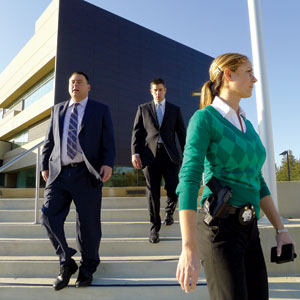
A walk through the sprawling, state-of-the-art police substation at Great Oaks Boulevard on the south side of San Jose feels like window-shopping a foreclosure. But the truth is, a group of six is perusing the future home of more than a third of San Jose’s police force. When that scenario will come to pass is impossible to say.
Voters approved Measure O in 2002 to bolster public safety throughout San Jose, and the city started issuing $159 million in bonds, with much of the money intended for constructing the substation. Nearly 10 years later, those ambitious days seem like a distant memory.
The 107,000-square-foot facility—officially completed at the end of 2010 at a cost of $90.8 million—is currently one of five publicly funded buildings in the last 15 months that have yet to open or were closed the same day they were completed.
A decade of budget shortfalls has left the city with no option but to keep the substation shuttered along with the Bascom Library and Community Center ($28.4 million), Calabazas Library ($7.4 million), Educational Park Library ($10.7 million) and Seven Trees Library. (Seven Trees did open the community center portion of the building; the total cost of the project was $34 million.)
Leaving aside Seven Trees, the city has spent more than $137 million on four public facilities that deliver no public services.
Leading the processional through the substation are Police Chief Chris Moore and David Printy, a senior architect for the Public Works Department, which maintains control of the substation for now. The tour starts with a look at a piece of artwork in the entryway that features a grid of San Jose.
“An array of LED lights ties to an infrared camera,” Moore says. “As you walk through the site, [the artwork] takes an infrared image of you and any moving object. It’s a little more impressive at night.”
For now, like the facility itself, the artwork remains dormant. Even an environmentally friendly living roof layered atop the building seems to lack life. Seen from the vast, cubicled offices and meeting areas throughout the second and third floors, weeds have overtaken the overhangs. Conference rooms to discuss crime fighting strategies have chairs but no bodies. Sophisticated scramble pads to unlock doors of holding cells go untouched. Not a single cruiser parks in the expansive subterranean garage.
San Jose is the largest city in the nation without an operational police substation, and no one seems to know when that will change, as police officers could face layoffs for the second straight year. It would cost almost $4 million a year to operate and staff the building, according to the police chief.
“Everybody wants it open,” Moore says. “The reality of the budget is it won’t be in fiscal 2012–13. But 2013–14? We’re hoping.”
San Jose City Councilmember Ash Kalra, whose district includes the substation, has similar hopes but admits that might be wishful thinking.
“It’s highly unlikely we’re going to see the police substation any time soon,” he says, “because if I have to vote for opening a substation or having patrol officers, just like anyone on the council, I’m going to choose patrol officers.”
Not a Bunker
In 2006, San Jose Police Chief Rob Davis submitted a five-year plan to the council that recommended adding almost 600 new personnel positions. There were more than 1,300 SJPD staff positions at the time, and Davis lamented the department’s inability to deal with property crimes.
Currently, the department has less than 1,100 officers and there are no plans to add any soon. If anything, more officers are expected to retire or transfer to other cities. Meanwhile, SJPD announced last month that it will no longer respond to property alarms unless a witness follows up with a report.
{pagebreak}
San Jose’s police substation could house about 450 officers, according to Moore, who says that is the same number of officers now expected to join the force by 2027. Uncertainty affects every part of the drama at City Hall, from how Moore and City Manager Debra Figone apply for federal grants to officials questioning Mayor Chuck Reed’s focus on pension reform through ballot measures.
“It’s really frustrating, because if we shifted our focus to police staffing and keeping community centers and libraries, and then looked at our debt and how to serve the community with being fiscally responsible, then I think we would open that substation sooner,” says Kalra, who has been at odds with Reed on the legality of pension reform ballot measures.
Because bond money built the substation, it can’t be sold or used for anything other than its initial use. Luckily for San Jose, and many other municipalities across the country that are looking to reduce costs of public buildings, community centers and libraries can be designated for reuse by nonprofits and cultural organizations.
Currently, 29 of the 35 facilities in San Jose designated for potential reuse have left city hands. Depending on the lease agreements, the city still pays for some maintenance costs.
“It saves the city money in that we don’t have to operate the facility, we don’t have staff there or programs there,” says Matt Morley, San Jose’s deputy director of facilities management.
The elephant in the room, however, will continue to be the substation, which despite being useless at the moment still has no shortage of admirers.
“For all those security provisions, we were able to also make it a very enjoyable place to be,” says Printy, who as a senior architect with the city had a hand in picking the site as well as navigating through the challenges of construction. “It’s not a bunker, and certainly our direction was, ‘Don’t build a bunker.’”
In a time when morale is admittedly lower than at almost any time in the department’s past, a change of scenery to new digs for some officers could make the substation a facility that could lure officers into staying or joining the force.
“It’s like the saying, ‘When you feel good, you work good,’” says Sgt. Jason Dwyer, a public information officer also on the substation tour. “It’s as simple as that.”
Later in the tour, Chief Moore admits that excitement over the substation will come with complaints once the building is put into use. But his comments seem to also speak to the greater issue that San Jose finds itself in—owning a host of new facilities built with bond money but having no plans for the future.
“The day we move in,” Moore says, “people will go, ‘You know what, we should have done this.’”
 Review: Village Falafel
  Gaslighter Theater to Remain Dark