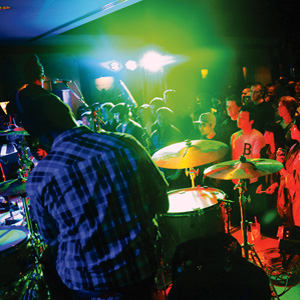
A few years ago, about 10 venues hosted live music in San Jose’s downtown—a decent number for a run-of-the-mill suburban town, but hardly impressive for a bustling metropolis. Security was tight then, too, as the city required two bouncers for every 100 patrons based on the fire marshal’s designated maximum occupancy. This was done partly to alleviate a pervasive perception that the heart of the city was unsafe.
For Lee Wilcox, a city-employed liaison between downtown businesses and the city manager’s office, that wasn’t a robust enough live entertainment offering for a place the size of San Jose. Business owners he talked to overwhelmingly agreed.
Wilcox teamed up with the San Jose Downtown Association and individual arts advocates to breathe some life into local entertainment—and to convince the City Council to lower the price of entertainment permits and cut down on the number of security guards a place needed to run a live event.
The plan worked well enough that the city changed its tune. After years of prodding, city officials agreed in 2010 to make it cheaper to get entertainment permits, changing them from two- to four-year agreements and doing away with them altogether if a venue is small enough.
The savings for various types of permits ranged from about $500 to nearly $2,000. And instead of two bouncers for every 100 patrons on the max occupancy, the city agreed to drop it to one per every 50 people actually onsite. The revision also allowed security guards to start their shifts when entertainment actually began—or 9pm at the latest, whichever came first—instead of at the venue’s opening.
It was the second time the city had updated its entertainment ordinance since creating it in 1997 to curb cruising, public nuisances and underage kids staying out late at night.
Despite notable closures downtown since the latest revision a couple years ago, such as Voodoo Lounge and Toons, the number of regular live music events has tripled, Wilcox says. The musical landscape began to shift, grow and make way for the hint of a revival in local grassroots talent.
“Downtown stakeholders really just wanted the city to listen to them, to let them have the freedom to create more opportunity for live music,” Wilcox says. “The city did listen … and we’re now seeing more of those opportunities in place.”
Chris Esparza, 45, who for years ran some of the biggest music shows, festivals and established nightclubs in town, has watched the city’s art culture ebb and flow the better part of two decades. What a city of San Jose’s size needs, he says, is every step of the stairway, from open mics to sold-out shows at massive arenas.
“For years, half the staircase was missing,” Esparza says. “As the ecosystem goes, we’re still hurting a little bit on the venues. We need more mid-sized ones and, yeah, more of the smaller ones to give people a chance to start somewhere.”
An example of the outgrowth of live music is the Sept. 22 Silicon Valley Sound Experience (SVSX) music festival taking place at venues throughout downtown San Jose. (Disclosure: Metro is sponsoring the event.)
A strong musical, artistic culture incorporates more than just the nonprofit-driven opera, ballet and other well-established performance arts, Esparza says. But San Jose’s still a little slow to the take, he adds.
Toons, Voodoo and the 23-year run of Music in the Park have all gone away in the past few years. Esparza considers the present music scene much livelier than when he first moved to San Jose in the early 1990s, back when he started his first nightclub. Then, he recalls about three other venues that hosted live music two to three times a week. A decade ago wasn’t much better, he says.
South Bay born-and-bred singer/songwriter Chris Reed, 29, echoes Esparza’s sentiment that civic leaders need to have faith in the creative force of Silicon Valley, which is better publicized for technological than artistic breakthroughs.
“This year alone, I have noticed that the entire art community here in San Jose has started to become a little more mainstream,” says Reed. “The music culture [here] is unlike most cities. It’s just a shame that there are only a few places. There is certainly no shortage of talent.”
Roger Springall, who owns the live-music-friendly coffee shop Caffe Frascati on South First Street, agrees that it’s just a matter of giving creative types a place to go and letting business owners enjoy enough freedom to host them.
“One of the reasons I opened Caffe Frascati was because there was nowhere downtown that was under-21 friendly where I could have a beer, he could have a soda and we could hang out and see great local musicians performing,” says Springall, whose son was a teenager when Frascati, formerly Cafe Trieste, was founded four years ago. “It would be great to see downtown San Jose become known as a place where you can always find good local musicians performing.”
Paul Kimball, the 44-year-old lead singer/songwriter of local folk rock/country group Careless Hearts, says that those kinds of caf—type venues help connect a new audience, garner fresh interest from people who happen to stumble into a place as opposed to the ones who go online and shell out $50 for a ticket to a band that already claimed their loyalty.
“It has the potential to be really valuable,” says Kimball. “Anytime you can be in an environment where people can be turned on to something new, that’s great. It’s about being in front of a stage, you, the audience, make it cool. You’re helping the entertainer grow.”
When the city hired Wilcox, downtown stakeholders, promoters, entertainers and other residents felt like their ideas were getting more traction than they had been.
Four years after his hire, Wilcox has gained the trust of a host of other downtowners.
“He’s completely chipped away at a pretty good clique of downtown business owners and convinced the powers that be to change the rules that everyone was pulling their hair out about,” Esparza says. “And the city trusts him, too. It’s hard to make a lot of change in his world, but we’re seeing it happen.”
Wilcox admits there’s a ways to go before the local music scene catches up to San Francisco, Portland or South-by-Southwest headquarters, Austin, each considered hotbeds of musical innovation, scouting grounds for up-and-coming talent and destinations for music lovers all over the country.
“If we’re going to improve live music in downtown, we need homegrown talent,” says Wilcox. “We need the kids in high school to feel encouraged enough to perform—and for that to happen they need a place to play. And for more established musicians, we need to make sure they have enough stage time at small or mid-sized venues in addition to the larger ones.”
The city’s trying to support private brokers in getting defunct nightclubs filled again, Wilcox says. In the meantime, spots such as San Pedro Square Market’s open-air plaza are quickly become local musical destinations. The Pagoda also popped up in the past couple years, and the club at the Fairmont holds shows in a range of genres, from reggae to rock to Top 40.
“You have to think of things in the long term,” says Jerry Sauceda during a break at a recent live show at Cabrito’s, a Mexican bar and grill on South First Street. “It’s good that we’ve grown musically as a city in the past few years, but we have to think about how to make this a part of San Jose 10 years, 20 years, 30 years from now.”
 Halloween at Winchester Mystery House
  Collapse at Historic Hoover Theater