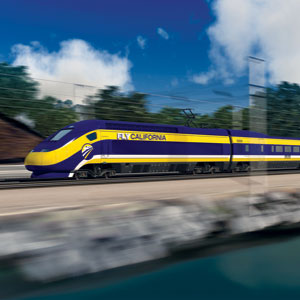
Two Silicon Valley cities are standing in the way of high-speed rail, according to fast transit cheerleaders, and California’s bullet train could bypass San Jose as a result.
A report released Monday by the High-Speed Rail Authority reiterates the authority’s consistent argument: A tunnel and underground station will not work in San Jose. Business and neighborhood groups worry that the proposed elevated structure will be a huge and unsightly addition to the cityscape.
What the report does not say — yet it is being discussed internally by HSRA officials — is that the city’s advocacy of a tunnel option could push the $98 billion high-speed rail line to take an alternative path.
Commonly dismissed as absurd by Silicon Valley’s mass transit proponents, the alternative high-speed rail connection from Southern California and the Central Valley would use the Altamont Pass in the East Bay as its gateway to San Francisco. The idea has been thrown out in the past. It is gaining steam now on the heels of last week’s legal ruling, which forces HSRA to reopen environmental analysis of the stretch through the Pacheco Pass between the Central Valley and Gilroy.
“If we can’t come to some sort of resolution, the authority will ultimately have to look at other alternatives,” says Dan Leavitt, a deputy director with HSRA. Leavitt admits that, as of right now, the only alternative stop in between Fresno and the peninsula is Altamont.
HSRA officials came to San Jose in late October to express their opposition to examining a tunnel option. Roelof van Ark, CEO of HSRA, and Leavitt met with Mayor Chuck Reed and his staff for almost an hour, but city officials exited the meeting unmoved.
“[HSRA has] consistently, from the very first time, said that they think a tunnel option is not constructible and will not be permitted nor funded by the Federal Transit Administration,” Reed says. “It’s not that I agree or disagree with them. I’m not an engineer.”
Reed has aligned with councilmembers Sam Liccardo and Pierluigi Oliverio, whose constituents will be affected by an aerial high-speed rail line, says Rod Diridon. The former Santa Clara County supervisor and longest-serving HSRA member until late last year, says the additional cost of mining tunnels, along with groundwater issues, make any complaints about the aerial bridge’s noise and aesthetics moot.
“There is a groundwater lake underneath us in San Jose. The only way you can stabilize it is to inject chemically-treated grout, like a slurry cement,” Diridon says. “What you would be doing, in effect, is building a long dam across the groundwater. In the future, water is going to be much more valuable than petroleum, and to think of us putting chemically treated grout into our ground water is absolutely ridiculous.”
{pagebreak}
Yet, Diridon says, San Jose officials are running the risk of being displaced by Altamont as they continue to raise objections like those involved in the recently resolved lawsuit against high-speed rail, which included the city of Palo Alto as a plaintiff.
“If you had asked me two weeks ago, I would say absolutely Altamont will never happen,” Diridon says. “But the judge has reopened the issue. If we can’t find a route that satisfies that judge, from Gilroy to San Jose, then the alternative we have to get from the Central Valley to San Francisco is the Altamont Pass.”
Others who want the best result for San Jose think that all the Altamont talk is a negotiating ploy. Mayor Reed, who delayed the council’s consideration of visual design guidelines from this month to March of next year as the authority weighs options, doesn’t give credence to the alternative route. He says HSRA officials only mentioned it in passing at their most recent meeting.
“There are certainly people here locally who are saying we should give up on the San Jose and San Francisco route and look at Altamont,” Reed says. “We didn’t talk about it very much, because it’s a stupid idea. There are people who think pigs can fly; it doesn’t mean they can.”
City Splitters
Last Thursday, several non-profits as well as the cities of Menlo Park, Atherton and Palo Alto were declaring victory in their fight to reopen the Pacheco environmental analysis.
High-speed rail was approved by California voters in 2008, when the total project had a $33.6 billion price tag and was expected to be complete by 2020. HSRA officials released a new report earlier this month listing the cost at nearly three times that amount when adjusted for inflation, with a completion date of 2033.
Palo Alto has been one of the most aggressive opponents of high-speed rail, and on Tuesday the city held its first legislative public hearing, which van Ark attended. A day earlier, Palo Alto Councilmember Larry Klein proposed that the city ask state legislators end the project or ask voters to defund it.
It seems the latest lawsuit ruling involving high-speed rail has only emboldened opponents—which are numerous in Southern California areas such as Palmdale and Bakersfield.
“The dominant theme has been the HSRA doesn’t really listen to the citizens’ concerns for the project,” says Adam Summers, a policy analyst for The Reason Foundation, a libertarian think-tank based out of Southern California. “They are just kind of going full speed ahead with whatever they want to do without taking into consideration any of the disruptive factors citizens are concerned about.
“You’re talking about thousands of homes and business that are going to be destroyed, as well as farmland. The more people learn about how much the system is going to cost, how destructive it will be in our day-to-day lives, the more they will object to the project.”
The aerial line, Councilmember Liccardo believes, would effectively split the city—a complaint echoed by peninsula high-speed rail opponents. The massive concrete posts and underpasses would be targets for graffiti and shadowed venues for urban blight. Home and businesses would likely be confiscated through eminent domain.
With construction of the rail line’s first stretch slated to begin next year, from Fresno to Bakersfield, not much time remains before the authority must decide whether Northern or Southern California gets connected to the Central Valley first. Indecision over tunnels will certainly play a factor. And while high-speed rail has its critics, it also seems no one wants to be left out.
“That decision on a tunnel is far from made, so let’s back up for a moment,” Liccardo says. “If you’re building a train that’s supposed to connect northern and southern California, and you miss Northern California’s biggest city—the heart of the nation’s tech industry—you’ve built a train to nowhere. And that’s not likely to make a project that has already had its public challenges any more popular.”
 Fight Preview: UFC at HP Pavillion
  Live Feed: Raw power