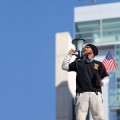
Nate Roybal is part of the 99 percent. A 24-year-old salesman for a Mountain View telecommunications company, Roybal has unpaid student loans for a degree he never completed. His income keeps him just above the poverty line but doesn’t allow him to pay his bills. For nearly two weeks, Roybal has spent his days working a full shift before driving his car to San Jose to sleep in a tent.
Along with other students, day laborers, retirees and people who have simply given up hope of finding a job, Roybal is part of the loosely organized Occupy San Jose, an offshoot of the Occupy Wall Street movement that is rallying the disgruntled and disenfranchised against the rich in cities across the country.
“There is something wrong with this country when people work 40 to 60 hours a week and can’t afford health care or even to move out of their parents’ home,” Roybal says, taking a drag off a cigarette minutes before an occupation meeting is set to start. “A lot of people say ‘that’s just the way it is.’ I’m trying to change that.”
But despite giving off the appearance of growth—a rally of 200 people gathered Sunday in front of City Hall to air their grievances over a system they say unjustly rewards the wealthiest 1 percent of Americans, speculative banks and corporations looking to influence elected officials—Occupy San Jose finds itself at a turning point.
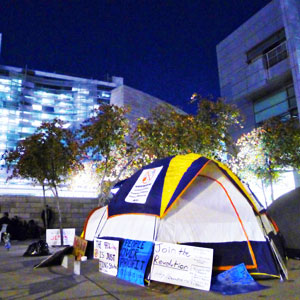
The group had five tents lining the sidewalk of City Hall plaza for a week, when between five and 20 people would sleep to the sounds of sirens and passing pedestrians each night. Yet the threat of citations and arrests has pushed some of the protesters off city property and up three blocks to the Peace and Justice Center on South Seventh Street. Only a few people chose to remain at City Hall the night of the group’s largest rally. Five people have been cited by police, according to one protestor.
Hundreds have been arrested in protests in New York, which began Sept. 17 on the streets of Manhattan. Since that time, more than 900 occupation groups are estimated to have sprouted up in other cities across the country. But cohesion and consistency of message has been an issue.
New York’s occupation group put out a declaration that ticked off a broad set of objections. The list touched on everything from foreclosures, bank bailouts, agricultural manipulation, the mistreatment of animals, and labor negotiations with unions to exorbitant student loans, a broken healthcare system, wars abroad, corporate donations, unsafe products not being recalled and a national commitment to colonialism. The list goes on.
But some local groups, such as the people pushing for a referendum on San Jose’s pot club program as well as voter registration gatherers, are hooking on to the local occupation movement for their own benefit.
“These are people who are taking advantage of the Occupy Wall Street organization. They don’t represent the view of us,” says Peter Brown, a marketing professional who supports Occupy San Jose. “The Tea Party got preempted by the Republican Party, and that’s what we want to avoid.”
Unlike the Tea Party, which scared off many yet gained political clout with its red-in-the-face rhetoric, Occupy San Jose doesn’t have the demographics of a 4-H Club potluck. Its diverse members seem like genuinely happy people when not talking politics. The rub comes up when discussing money, power and greed.
“There are a lot of demands, and they’re growing,” says 41-year-old Martin Truong, who is involved in both the San Francisco and San Jose occupation movements. “The criticism that we’re unfocused is propaganda.”
Members of Occupy San Jose, which has several take-charge coordinators but no true leader, say the biggest boon to the nationwide occupation is that, so far, there seem to be no behind-the-scenes moneymen. While people in the Tea Party were happy to talk about being mad as hell, few seemed to know they were being prodded by political action committees funded by right-wing millionaires and billionaires, such as the Koch brothers.
“The Tea Party was Astroturf,” Truong says. “This is grassroots.”
{pagebreak}
What’s Next?
At a typical service at First Unitarian Church in San Jose, a homosexual atheist could be sitting next to a black Buddhist holding hands with his Hindu wife. Nancy Palmer Jones looks out over this service of 160 people each Sunday.
“It’s like a little picture of the world,” she says.
Bringing together a variety of viewpoints, Jones says her church’s goal is “to take from all wisdom sources in world.” There is also an emphasis placed on tolerance and social justice. When one Unitarian member from Palo Alto first talked to Jones about a group that was protesting corporate greed and economic inequalities in San Jose, the reverend was all ears. “I do believe there is a tide turning that is calling us as U.S. citizens for a more compassionate, justice-centered system,” Jones says.
Last Sunday, members of Jones’ congregation joined Occupy San Jose at the City Hall rally. They weren’t the only newcomers. The South Bay Labor Council also lent its official support to the occupation last week. For the first time in a while, public employees weren’t being attacked like political pi–atas. Even the harshest critic of pensions in Silicon Valley, San Jose Mayor Chuck Reed, seems to be a supporter of the 99-percent movement.
“I have a lot of sympathy for some of the issues they’ve raised,” Reed says. “San Jose has its own argument with Wall Street bankers.”
The city is currently embroiled in a multi-million dollar anti-trust lawsuit with Wall Street. The complaint, which includes other cities, claims brokers and municipal-derivative providers rigged the market for city bonds. The lawsuit names Bank of America, Merrill Lynch, UBS, Citibank, Citigroup, Morgan Stanley, Goldman Sachs and others as defendants.
Sympathy only extends so far when it comes to city code, though, which is why protesters are being ordered to move off the plaza.
In 2008, the city didn’t enforce code that forbids protesters from camping at City Hall. Ly Tong, a Vietnamese activist, camped on the plaza for roughly a month because he wanted a section of Councilmember Madison Nguyen’s district to be called “Little Saigon.”
Matt Morley, the deputy director of the Public Works department, says the city regrets that decision and has been in contact with protesters about not being allowed to camp out past 11pm.
“It’s better to work with people than try to create a burden on the police department and a burden on the jails, if it gets that far,” Morley says. “I don’t think anybody wants that.”
A showdown was expected last Friday night but no one from the police department or city arrived at the scene. Instead, a few of the protesters moved to avoid fines to the less-trafficked area in front of the Peace and Justice Center.
It’s still too early to say how the fractured camps will affect the local movement. But the mayor thinks both locations miss the point.
“They ought to be over in front of the federal building,” Reed says. “They’re kind of missing some symbolism.”
 Quatuor de Bordeaux
  Death Race