When cell-phone- clutching Tunisians mobilized mass protests in late January to confront their kleptocratic rulers, Clay Shirky watched from his home thinking, “Oh God, please let this work. Please, not another Tiananmen.”
When the army joined the protesters and Tunisia’s president Ben Ali was forced out of power, Shirky said he felt “immense relief.”
Shirky, a media theorist and professor at New York University, had written an essay which was at that very moment on bookstore shelves in Foreign Affairs, the premier journal of American foreign policy. Titled “The Political Power of Social Media,” Shirky’s piece precisely predicts the events taking place in the Middle East.
It describes instances from around the globe where insurgent groups had learned to “weaponize social media” such as Twitter and Facebook—using them not just to tell the world what was going on, but also to synchronize their actions.
“Social media have become coordinating tools for nearly all of the world’s political movements,” Shirky writes. “Just as most of the world’s authoritarian governments are trying to limit access to [them].”
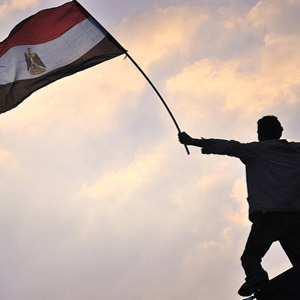
Tunisia’s “Twitter Revolution” spilled over into Egypt, where Hosni Mubarak’s regime teetered and then fell. The uprising, still powered by citizens using online tools and mobile devices, has since spread to Libya, Syria Yemen and Bahrain.
Speaking Tuesday from his office at NYU, Shirky said it is no exaggeration to suggest that the political world is being fundamentally altered.
“It has been just over 100 days since Ben Ali fell,” Shirky said. “So the world we’ve been theorizing about for 10 years, in which ordinary citizens are empowered with these tools, has been the world we’re living in for only 100 days.”
In the Foreign Affairs piece, Shirky traces the rise of politicized social media tools to the 2001 impeachment trial of Philippine President Joseph Estrada, during which 7 million text messages reading, “Go 2 edsa; Wear blk” resulted in a protest a million strong. He writes about the 2009 Green Wave uprising in Iran, when activists used modern communications technologies to coordinate widespread protests against the rigged election that returned Mahmoud Ahmadinejad to power. Both of those uprisings were squelched by violent government backlash.
In our interview, Shirky noted that despotic leaders are facing an unprecedented challenge.
“What we learned in the Philippines and what we learned in Iran is that autocrats can prevail if they are willing to kill their own citizens,” he said. “But now we are seeing that even Muammar Gaddafi does not want to murder too many of his citizens in the broad light of day. And the presence of people with camera phones makes it all but impossible to stage a massacre without consequences.”
{pagebreak}
Shirky said he saw the assignment from Foreign Affairs as an opportunity to “send an unsolicited memo to the State Department,” and his essay does read a bit like a “Dear Hillary” letter. In it he praises the State Department for taking steps to ensure that the world’s citizens have access to The New York Times and Wikipedia by pushing for international anti-censorship rules. But Shirky argues that it is more important to focus on sites that allow back-and-forth communication.
“Access to information is far less important, politically, than access to conversation,” he writes.
This means Facebook and Twitter, but also homegrown community forums, blogs and even dating sites. He also urges the State Department to think about small-screen devices.
“As a practical example of this, the United States should be at least as worried about Egypt’s recent controls on the mandatory licensing of group-oriented text-messaging services as it is about Egypt’s attempts to add new restrictions on press freedom,” he writes. “The freedom of assembly that such text-messaging services support is as central to American democratic ideals as is freedom of the press.”
Shirky has become the most widely respected thinker in the social media space since the publication of his 2008 book Here Comes Everybody: The Power of Organizing Without Organizations. It was in that book that he first revealed a new way of thinking about social media in political terms.
To illustrate the concept, he tells the story of the Blitzkrieg of 1939-40, when a small Nazi force of Panzer tanks was able to overwhelm and defeat a larger and better-armed French army.
“Although the Panzers had smaller guns and less armor, they came with one thing the French tanks didn’t have: radios. We don’t often think of a radio as a weapon of war, but the radios allowed the Panzer commanders to share information and make decisions in the heat of battle. While the French, limited in their communications with their tank commanders, were hampered in their information gathering.
“The radios turned the Panzers from stand-alone pieces of military hardware into a kind of coordinated group weapon.”
To Shirky, online social media and hand-held devices just might put that same kind of leverage in the hands of the world’s citizens. He points to that fact, and the 2005 U.N. doctrine mandating the community of nations’ “Responsibility to Protect” people under attack from their own leaders, as evidence of a new political landscape: “We are living in extraordinary times.”
 Galileo’s Daughters
  Livefeed: Italian American Heritage Foundation