Description
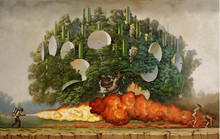
Catharine Clark Gallery is pleased to present Scott Greene’s solo exhibition of new paintings, Capitulare de vita, in the main galleries, and Marina Zurkow’s video installation, Elixir Series, in the media room. The exhibition dates are July 10–August 21, 2010, and Greene will be present for the opening reception on Saturday, July 10, 5–7pm.In his third solo exhibition at Catharine Clark Gallery, Scott Greene explores the balance between the natural environment and artificial constructs. In an interview with Greene, he speaks of questioning the notion that the two are mutually exclusive, and that one could argue that beauty in nature is a construct, and that all human activity no matter how artificial and deleterious to the environment, is natural in accordance with evolution. The exhibition’s title, Capitulare de vita, is derived from Capitulare de villis, an edict issued by Emperor Charlemagne in 812 regulating the administration of his crown estates, and including lists of herbs and trees that should be grown in every imperial garden. Replacing villis (home or garden) with vita (life), Capitulare de vita loosely translates to “capturing life, or an inventory of life.” Rife with his visual iconography—satellite dishes, trees, extension cords, sheep, oil barrels—Greene’s visual exploration is an inventory of the stuff of estates, of life in a corporatocracy, and of the flora and fauna in what remains of the ‘garden’.” In the painting titled Expulsion II, the satellite dishes serve as the “forbidden fruit” from the Tree of the Knowledge of Good and Evil, and Adam and Eve are expelled from the Garden by a flame-thrower. A symbol of technology and the exchange of information, Greene’s ubiquitous satellite dish is a timely reference to growing international censorship, and the general breakdown of meaningful and constructive communication.
---
Presented in the media room is Marina Zurkow’s Elixir Series. The series describes impossible landscapes: cut-crystal bottles bobbing and tossing like buoys in the ocean, beacons bearing potions, poisons, messages, and genies. Each bottle contains an animated figure engaged in a repeated, metronomic action. In Elixir I, a woman is rowing; in Elixir II, a blindfolded man stumbles to stay upright. Elixir III holds a young girl trying to fly with paper wings; and in Elixir IV, a high-diver twists and arcs, while the bottle presses forward in an Antarctic landscape. The highly layered video treatment pays tribute to the 19th century Russian painter Ivan Aivazovsky, whose portentous, luminous paintings of tiny ships on huge swells of ocean both mesmerize and terrify the viewer. The exhibition is an expansion of the single work from the Elixir series presented in June.


Comments