
Description
If the question were asked, Who forged the genre that is known today as modern country music?, only a tiny group of country immortals could step forward to share the spotlight. One, out of that select handful, would be Merle Haggard. Merle wasnt in the delivery room on the morning country music was born; it simply seems like he was. And you wont hear anybody refer to him as the father of country music. But many will swear hes at least its godfather.What gray poupon has meant to mustard, Haggard has meant to country music. Like rock n roll without Presley, and like Sears without Roebuck, country music without Haggard simply isnt!
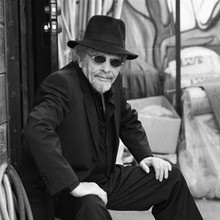
Few country devotees, be they oldtimers or neophytes, are unfamiliar with the craggy Haggard mask of a thousand photographs - that countenance thats been etched by time and experience like the granite face of your favorite cliff. And even fewer are those who are unfamiliar with the evocative Haggard delivery that has spawned an entire school of country vocal stylists.
In the ever-expanding array of country music stars, hitmakers and idols, Haggard walks in no mans shadow. Instead, he casts a far-reaching shadow of his own. Rare is the country balladeer that has mastered the idiom at so many different levels as has he.
In listening to his uncanny craftsmanship, one quickly recognizes that this is a consummate troubadour who could have carved his niche as either a songwriter, a musician or a singer, so gifted was he in all those areas. Instead he chose to expand and hone his talents in many dimensions simultaneously, developing his name as the quintessential country artiste, rural Americas Renaissance man, whose caliber will long provide a standard for all country artists who follow.
Haggards life path has never been easy, nor has much of it been pretty, as aired in his 1981 book, Sing Me Back Home. His childhood years were spent in Bakersfield, California, and the death of his father, when Merle was just nine years old, became the catalyst that led to a squandered youth. At the same time, his love for the wandering songs of such as Jimmie Rodgers, lead to an errant passion for the gleaming, endless railroad tracks and the siren song of slow freights and hobo jungles. And, along the way, to numerous brushes with the law.
Unfocused, unruly and unsettled, Merle learned early to walk the mean streets. As a teenager he took on every unskilled job that would have him, from oil field roustabout to hay-pitcher to short order cook. And that was the bright side. He also saw the insides of various penal institutions for crimes ranging from burglary to auto theft and even to escape. Before he had reached the age of 21, and not long after he married his first wife, Leona, he was serving time in the notorious San Quentin Penitentiary, thanks to a bungled attempt at burglarizing a tavern. But the three year stretch within those gray and desolate walls, including a stint in solitary confinement (for making home brew), became the experience that finally changed his perspective and the spark that turned his head around. He abruptly assumed the role of a model prisoner and was paroled in 1960. (Over a decade later, in 1972, Californias governor Ronald Reagan granted him a full pardon.)
By the time he regained his freedom, he and Leona had four children, but the marriage had already fallen apart. But better times loomed just around the corner. Post-prison life, a typical tale of scratching out a meager survival, also became the beginning of his untypical musical career. Although he had made his stage debut at 15, sitting in on a Lefty Frizzell performance, it wasnt until after San Quentin that Merle joined a band as rhythm/bass guitarist and began to sing in the clubs and the dives of the infamous beer can hill area of Bakersfield.
In one brief stretch his life took a major turnaround. He was signed by Tally Records, owned by close friend Lewis Tally, and began cutting singles in a garage behind Tallys house. His first single was Singing My Heart Out, which received some regional airplay on the West Coast, but it was in 1963 that he eventually broke into the top twenty of Billboards country charts with his first national hit, Sing A Sad Song.
Since then the country charts have been his second home. His next few singles -- (All My Friends Are Gonna Be) Strangers, Swinging Doors and The Bottle Let Me Down -- all landed within the Top 10. Meanwhile, in the midst of this exciting period, he married Bonnie Owens, who also recorded for Tally, and his contract was sold to Capitol Records. And his career was ready to soar to rarefied heights. In 1966 he entered the Number One spot for the first time with Im A Lonesome Fugitive, and he won his first Top Male Vocalist of the Year award from the Academy of Country Music.
With a perfectionists attention to detail, he painstakingly pieced together his new band, The Strangers. His diligence in that area, as in many others, has not gone unrewarded. The Strangers since have become known as one of country musics finest road bands, and they themselves have been the recipients of a number of industry accolades, including being eight-time winners of the Academy of Country Musics Touring Band of the Year Award, as well as, a pair of Music City News awards for Band of the Year. They have also recorded several albums of their own.
In 68, the label released The Legend of Bonnie and Clyde, which, not unexpectedly, soared to Number One on all the trade charts. What was unexpected however, was the audience reaction to the B side. With absolutely no promotion or marketing input from the label, the side entered both the Cash Box and Record World charts and climbed to #23 (Cash Box). That song, Today I Started Loving You Again, went on to become one of the most important and lucrative songs of his career.
(Other of his famed B sides, including Silver Wings, (the flip of Workin Man Blues) also became strong audience pleasers, testifying to the impact of his casual and seemingly effortless craftsmanship.)
And, in 1969, with an assist from then band member Eddie Burris, he ventured into the arena of social commentary, voicing his feelings in Okie From Muskogee, the song that was to have the most dramatic impact on his career. Released during the height of national conflict over Viet Nam, it was also to be his most controversial. (And, another #1 record for Hag.)
At the end of the 70s, after over a decade with Capitol Records and of marriage to wife Bonnie, both associations came to an end. In 1977, Haggard signed with MCA Records and continued his long term lease on the #1 position with a string of chart-topping singles, including Think Ill Just Stay Here and Drink and Rainbow Stew. A year after signing with MCA, his marriage with Bonnie was dissolved. (True to the quizzical nature of his character, the two still remain friends, and Bonnie continues to sing and tour with Merle.) Immediately after his divorce from Bonnie, he married his third wife, Leona Williams, also a recording artist. And, eventually, Merle departed his longtime home area of Bakersfield. He relocated to his current home, a 150-acre spread on Lake Shasta.
In 1981, he signed with Epic Records, adding more #1 plaques to his wall, including Yesterdays Wine, the title single from his powerful album duet with country music titan, George Jones. That same year he released another landmark album with another legendary country singer-songwriter (and a longtime friend), Willie Nelson, who is now a member of the Country Music Hall of Fame. The title cut from that album, Poncho and Lefty, was also a Number One record for Merle.
In the mid-80s, he and Leona were divorced, and his later marriage to Debbie Parret also ended in divorce. Merle eventually married Theresa Ann Lane, his current wife, and the pair have two children, Janessa and Bennie.
Merle signed with Curb Records in 1990.
As a singer, Merle openly admits to borrowing the stylings of his idols, Lefty Frizzell, Bob Wills and Jimmie Rodgers, in his early years, and speaks of such beyond-the-genre influences upon his music as Frank Sinatra and Bing Crosby. Still, its his own charismatic individuality, along with those rich vocal textures that so well express the heart and soul of Haggard, that has always come shining through.
In addition to his vocal performance, he has also spent a great deal of time perfecting his instrumental skills. Over the years he has also developed into a remarkable lead guitarist, as well as a proficient fiddle player, both skills being woven into the fabric of his live performances.
What he has added to the archives of country music as a songwriter, however, will live on far beyond the prestigious accomplishments of the flesh-and-bones performer. In terms of style and material he has brought a dimension of lyrical depth and musical sophistication to country music that was heretofore unavailable. While the bulk of country song material of his time was dealing with the pangs of lost, found or unrequited love, Haggard was digging deep within his own emotional background and setting his dark and somber experience to music. Over the years Merle has become accepted as the bard of uncommon poems of the common working man, anthems born with dirt under their fingernails.
His early years of pain and tribulation provided him with infinite raw material to be spun into the rich imagery that is now indelibly imprinted on the idiom. His days outside the law were woven into Lonesome Fugitive, Sing Me Back Home and Branded Man, his understanding of his mothers torment led to Mama Tried and Hungry Eyes while his affinity for the hourly laborer produced such as Workin Man Blues and 5:01 Blues.


Comments