Eamon O’Kane
"Der Glasraum"
- When
- Event has passed (Thu Sep 9, 2010 - Sat Oct 16, 2010)
- Tags
- Arts, Galleries, Painting & Drawing
Description
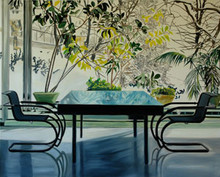
Gregory Lind Gallery is proud to present new work by Irish artist Eamon O’Kane. “Der Glassraum” is the artist’s first solo exhibition with the gallery and includes paintings and works on paper.In this exhibition, O'Kane explores the relationship between Philip Johnson's Glass House and Mies van der Rohe's Farnsworth House through a series of oil paintings on canvas and works on paper. Using the two buildings and their histories as a starting point, the artist plays with time, space, color and light in the series of paintings. The title of the show also references the Booker Prize shortlisted novel by Simon Mawer that creates a fictional story about Mies van der Rohe's Tugendhat Villa in Brno, Czech Republic. In the afterword of his book Mawer writes: “Raum is an expansive word. It is spacious, vague, precise, conceptual, literal, all those things…There is room to move in Raum.”
The paintings based on the Tugendhat Villa present interiors where the line between inside and outside is blurred. Natural elements creep in and begin to seemingly take over the architectural space. The artist also plays with reflections on the surface of the glass windows of the three houses, disrupting and abstracting the internal architectural spaces through layering the views of nature surrounding them. Plants appear to grow out of carpets in rooms and reflections of nature envelop the buildings.
Prospect Biennale Director Dan Cameron writes of the artist’s paintings, ‘Since at least 2005, which is when this writer first became acquainted with his work, O’Kane has used architecture as a jumping-off point for his meditations on nature by way of its mirror-opposite. One highly successful manifestation of this project is the ‘Ideal Homes’ series, in which iconic houses and housing styles from Bauhaus through Brutalism are transposed into idyllic settings, surrounded by lush sylvan landscapes that are only partially visible, but nonetheless designed to instill a kind of envy in the viewer for their impossible mix of utopian fantasy and bucolic sublime.’
O'Kane splices the buildings together, merging the seasons in alternating positive and negative colors. Along with works on paper which depict furniture, objects, interiors and architectural plan drawings, the show looks at modernism's ongoing legacy and the pursuit of a Utopian architectural space and its uneasy relationship with nature.


Comments