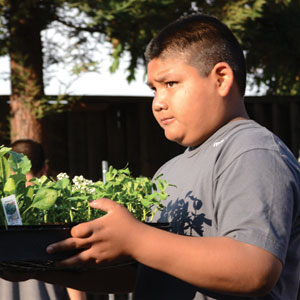
Leave it to the little guy to have the most ambitious of goals. But when Raul Lozano tells a story—the punch line often punctuated with an expression treading between a smile and a grimace—it’s clear his plans are no joke.
The founder of La Mesa Verde, the first organic-gardening program of its kind in Santa Clara County, wants to design a similar organization that reaches out to thousands of families across Silicon Valley.
Valley Verde, the ambitious lovechild of La Mesa Verde, will soon begin laying down roots in Gilroy, where agriculture is as ingrained in the culture as any area in Santa Clara County.
With the help of corporate sponsors and donations, plans are to start in April and, within a few years, provide free gardens to as many as 20,000 families. At least a quarter of those families will be identified as low income, which Lozano says has taken on a new meaning in recent years.
“When people think of low income, in these times it’s a whole different story,” he says. “It’s not the traditional struggle because the economy is so bad. Low income is the working poor and the unemployed.
“There’s a lot of issues of dignity and self-worth and they don’t want to identify with low income. The families that have been traditionally doing well, but aren’t now, need to access these services faster.”
A 2010 report by the Food Empowerment Project (F.E.P.), a nonprofit out of Santa Clara County, shows that low-income communities in the South Bay are drastically underserved when it comes to healthy food options.
Poorer areas have half as many large supermarkets as their wealthier neighbors—eight to 16. Federal statistics supplied by the North American Industry Classification System (NAICS) gloss over this fact, because corner stores that often specialize in liquor, beer and cigarettes are identified statistically the same as grocers such as Safeway, Lucky’s and Whole Foods Market.
“It’s no surprise. We knew what we would find,” says Lauren Ornelas, director of the F.E.P. “The higher-income areas have two to three times more fresh fruits and vegetables than the lower income areas. When the census tracks data in lower-income areas and higher-income areas, it looks equal, but it’s because they’re counting these tiny little liquor stores. Basically, Safeway is being counted the same as one of these friendship markets.”
The impact on the local Latino community is startling. In 2010, 68 percent of Latino adults in Santa Clara County were classified as obese, according to the health department.
Combating this epidemic, Sacred Heart Community Services and Lozano teamed up in 2009 to form La Mesa Verde, or the Green Table, which targets the Washington-Alma neighborhood in San Jose, which is predominantly Latino. The F.E.P. classifies the area as one of the most food-disenfranchised in the county.
“In the Washington-Alma neighborhood, in particular, we don’t have a food desert; we have junk-food swamps,” says Lydia Guel, director of self-sufficiency at Sacred Heart Community Service. “What we’re seeing in the successes of La Mesa Verde is folks aren’t excited just about the opportunity to garden in their home; they’re also coming back to support their neighbors.”
Maria Mora, a mother of two, is the head gardener for one family benefiting from La Mesa Verde. With the help of an interpreter, she says her garden has not only cut down on food costs as well as raised the nutritional value of meals—it’s also brought her family together.
{pagebreak}
“My husband has a background of coming from ranches, so when he comes home he spends more time gardening with the family,” Mora says, showing off her two garden beds that feature everything from cabbage, broccoli and lettuce to cauliflower, cilantro and chard.
Of La Mesa Verde’s first class of 100 families, 76 completed the first three growing seasons, which consist of two spring seasons bracketing a winter harvest. The families that dropped out of the program left for a variety of reasons, Lozano says. Usually a family member lost a job and/or their home; others lacked the dedication. “There were a couple that just weren’t gardeners,” Lozano says chuckling.
But not long ago neither was he.
Born in the “The World’s Fruit Basket”—Reedley, a little town southeast of Fresno—and raised in the fields of Central California, Lozano says there is hardly a fruit indigenous to California that he and his eight brothers and sisters didn’t pick.
Standing side by side with their parents, the Lozanos snatched up grapes, peaches, strawberries and watermelon in the valley. When the family moved north, they picked tomatoes in Mountain View and string beans in Half Moon Bay.
“It wasn’t like a joyful thing,” says Lozano, 57. “We did it on the weekends to pay for food and clothing.”
But the Lozanos didn’t directly benefit from the fruits of their labor, as the food they picked was always destined for the dinner tables of others.
A dirty secret about scraping by, then and now, is that markets in low-income communities often have exorbitant prices for fruits and vegetables. Customers opt to get what they can afford, and then they pay even more later on with their health.
According to the F.E.P., 28 percent of food locations in higher-income areas within the county had a salad bar and/or prepared salads. In contrast, just 3 percent of lower-income areas offered the same. But if La Mesa Verde’s results can be scaled to match Lozano’s vision for Valley Verde, the effects would be tangible.
After leaving his job of 13 years as executive director of Teatro Visi—n in San Jose, Lozano was looking for a new career challenge. His inspiration sparked after installing a new drip-system garden in his home’s backyard with a couple friends.
“I’m not an expert gardener or anything,” Lozano says, “but after we finished we were sitting under a tree in my backyard and I just said, ‘We should do this all over the neighborhood.’”
A little more than two years since then, Lozano still helps out La Mesa Verde in a limited role, but he left the organization last year to begin work on his new project. Guel says that his new venture has the chance to transform the way families in the county access their food, and as a byproduct it could raise the standard of living in the most impoverished areas. Until then, La Mesa Verde continues to carry on the torch.
“Raul had the initial brainchild,” Guel says. “We’re doing our best to continue the legacy he built. It’s important for us to finish what we started here.”
 All Star Academy in Santa Clara
  South First Fridays Art Walk Preview