Ending it’s current season, Opera San Jose’s new production of Gounod’s Faust felt a lot like leftovers. No doubt budget limitations had something to do with the minimalist set designs—even though the word “set’ in this case should not be taken literally; backdrops and arranged stage furniture, even with tricked-out lighting, barely qualify. Worse, the art chosen for those backdrops was depressingly inconsistent—a knockoff Brueghel harvest fest followed by a kitschy Thomas Kinkade landscape and, in the final scene, a clip-art starburst—and the key lights (one each for the principals onstage) reflected off the polished floor, creating ugly smears on those backdrops.
In 21st-century America, the once-popular Gounod opera needs all the help it can get. While it held the boards for an astounding run in France during the latter 19th century, it, too, is annoying inconsistent—theatrically and musically as frivolous as a Rossini farce but with occasional bursts of melodic inspiration. While the composer set his sights on countering the dominant Italian operatic tradition, he made no attempt to accommodate the theological and philosophical depth that Wolfgang Goethe had so brilliantly bequeathed to German culture. Instead, conflated emotions, pretty tunes and dances carry the opera.
OSJ’s general manager, Larry Hancock, describes the work as Gounod’s “masterpiece’ that puts all other operatic versions to shade. Yet Berlioz’s concert oratorio, The Damnation of Faust, is a greater musical score, has often been staged as opera to critical acclaim and would fit the OSJ stage. Where you’d expect from Gounod unforgettable melodies, during the “love scene’ at the end of Act II, you get nothing to hum on the way home. Instead, the best tunes show up when the characters are taking to themselves: “Salut! Demeure, chaste et pure’ is Faust’s vicarious musing on Marguerite. Her “jewel song’ is also a solo rapture. Mephistopheles, the most “complete’ character, gets his best musical moment in his final act “Vous qui faites l’endormie. … O Catherine, ma mie.’
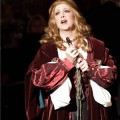
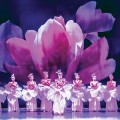
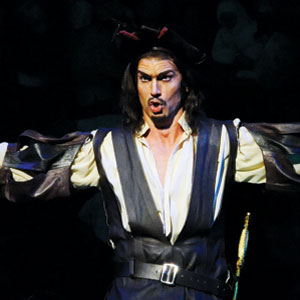
Last Sunday, on the California stage, Krassen Karagiozov (Valentin) redeemed the cast with his commanding and authoritative baritone. Vocally, Alexander Boyer (Faust) acquitted himself persuasively. Jasmina Halimic (Marguerite) was less demure than Faust imagined and hit some pretty strident high notes. But for the chorus and dancing, stage action was uncomfortably stiff. As Mephistopheles, Branch Fields’ vocal production came up short on diabolical menace though he was the most convincing actor. His putting the “crowd’ under spells made for bits of stage magic.
Conductor David Rohrbaugh kept the action in motion and sought to make space for the bigger moments. The orchestra came through, with concertmaster Cynthia Baehr floating lovely solo above Faust’s “Salut!’ in Act I.
Faust
Runs through May 6; $51 and up
California Theatre
 Man Gets Naked in Security Search before Flight to San Jose
  SJ Beer Walk Returns